
Home / Products / Ceramic / Food & beverage
Ceramic MF/UF · dairy, food & beverage
Recover your CIP caustic. Clarify the product. Keep the heat.
Caustic CIP runs at 120–176 °F (50–80 °C) and pH 12–13.5. That is outside the published limits of most polymer membranes. Ceramic handles both, so spent caustic can be cleaned and reused instead of neutralized and dumped. The same ceramic elements clarify juice, wine and beer and recover yeast, sweeteners and extracts.
Send us your CIP volumes or your product stream. We will size ceramic against it.
What plants tell us
The problems that bring food & beverage plants to ceramic.
“We buy caustic, use it once, then buy acid to neutralize it.”
Spent CIP caustic still carries useful strength. One dairy cut CIP discharge by up to 85% with ceramic microfiltration. Another plant reported 30% less caustic purchased and payback under 1.5 years.
“Our decanted caustic isn’t really clean.”
Settling tanks leave fines and a large sludge layer. Ceramic MF rejects over 99% of colloidal and suspended solids, including denatured protein and fat, while the caustic passes.
“Polymer can’t take the heat or the pH.”
PVDF UF is typically rated to 104 °F (40 °C) and pH 11 and embrittles in strong alkali. Ceramic CIP recovery runs at up to 194 °F (90 °C).
“Filter aid and centrifuges cost us product.”
Juice, wine and beer clarification and yeast recovery are long-running ceramic cross-flow duties. Ceramic gives a clear filtrate with no filter aid to buy and dispose of.
“Our hot, oily effluent fouls everything.”
Hot fatty effluent fouls polymer membranes. Published tests on 176–194 °F (80–90 °C) palm-oil effluent ran ceramic stably above 194 °F (90 °C), with 99.8% COD rejection. See hot oily emulsions.
Why ceramic fits
Built for this stream.
- Tolerates caustic CIP at full temperature and pH, and acid cleaning after it.
- Sharp solids cut-off: reclaimed caustic below 10 NTU in a published dairy case.
- Long life under daily hot cleaning. Ceramic outlasts spiral-wound membranes on CIP duty.
- Steam- and sanitizer-tolerant elements in stainless housings for product streams.
- Lower sludge, less neutralizing acid, less steam to reheat fresh caustic.
Typical stream conditions
What we size against.
| Parameter | Typical in this industry | What it means for the membrane |
|---|---|---|
| Spent CIP caustic | pH 12–13.5 at 120–176 °F (50–80 °C), carrying protein, fat, sugars and soil | Tubular ceramic; flat-sheet housing is limited to 113 °F (45 °C) |
| Recovery | 85–95% of the caustic reclaimed in published dairy cases | Strength adjusted after filtration, then back to the CIP tank |
| Dissolved COD | Ceramic UF retains 60–80% of COD; spiral NF retains 90–99% | Choose NF where dissolved load matters and the temperature allows |
| Product clarification | Juice, wine, beer, yeast, sweeteners, pectin, extracts | Alumina tubular, pore set by the product |
| Hot oily effluent | 176–194 °F (80–90 °C) in published edible-oil effluent | SiC or alumina tubular; recover the oil and the heat |
Ranges widely documented in industry literature. Your stream sets the design.
Projects like these
Where ceramic is already running on food & beverage streams.
Typical case types from ceramic membrane installations worldwide. Names, sites and sizes are withheld, and no single result carries over to your stream.
CIP caustic recovery
Spent caustic from evaporators, pasteurizers and process lines filtered and returned to the CIP tank.
Beer yeast recovery
Beer recovered from tank bottoms and yeast slurry by cross-flow ceramic.
Juice and wine clarification
Fruit juice and wine clarified without filter aid.
Sweeteners and extracts
Corn syrup and other sweetener streams, pectin and plant extracts clarified ahead of concentration.
Edible-oil process water
Oil recovered from hot emulsions so it can be sold or reused rather than sent to the sewer.
SiC or alumina
Which ceramic for this job.
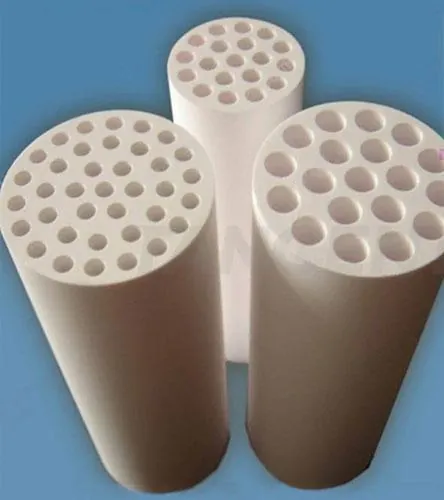
Alumina tubular is the usual food-plant choice: wide pore range, sanitary stainless housings, hot CIP. SiC tubular for the oiliest or highest-solids streams. SiC flat sheet suits cool wastewater polishing only. The standard SiC flat-sheet module housing is rated 41–113 °F (5–45 °C).
Ceramic flux depends on the application. As a general range, expect about 6–29 GFD (10–50 LMH) for non-pressurized (submerged) systems, and up to 100 GFD (170 LMH) for pressurized systems.
Warranty against defects in materials and workmanship. For industrial applications, membrane life depends on the service duty, so we run a pilot test to establish expected system life.
Honest selection
Spiral nanofiltration removes more dissolved COD from caustic and costs less up front, if your caustic is cool enough for it. Ceramic wins when the caustic is hot, dirty or both. For plant wastewater, an MBR is usually the right step. See food processing and dairy wastewater. Water reused on food-contact surfaces must stay safe and sanitary under food-safety rules widely documented in industry literature.
What to send
Feed first.
- CIP volumes per day, caustic strength and temperature (°F)
- Which circuits: evaporators, pasteurizers, tanks, lines
- Current caustic, acid and disposal cost per year
- For product streams: product, solids, target clarity or cut-off
- Sanitary or certification requirements
Lab or pilot testing on a sample is available before you commit.
Built and backed in the USA.
Ceramic elements come from certified sources, and the quotation documents their origin. Zyramic supplies the modules, and frames and skids are assembled in our Poughkeepsie, NY shop.
We presently have a manufacturing facility in Poughkeepsie, New York, and the ability to ship from Europe and Asia.
On a federally funded job? Tell us your domestic-content requirements, including Build America, Buy America (BABA), and we'll review what we can document.
Zyramic, Inc.
14 Tucker Dr, Suite 4
Poughkeepsie, NY 12603
845-402-6318 · tom@zyramic.com
Related: Dairy wastewater (MBR) · Food processing wastewater (MBR) · UF for food & beverage water reuse · Acid & caustic recovery · Ceramic modules