
Home / Applications / RO pretreatment
RO pretreatment · Submerged UF · No backwash
UF for RO pretreatment, without the long train.
Scrub UF puts flat-sheet ultrafiltration in an open tank, kept clean by circulating media. In many cases the pretreatment ahead of it is a fine screen, so it can replace coagulation, clarification and media filters ahead of your RO.
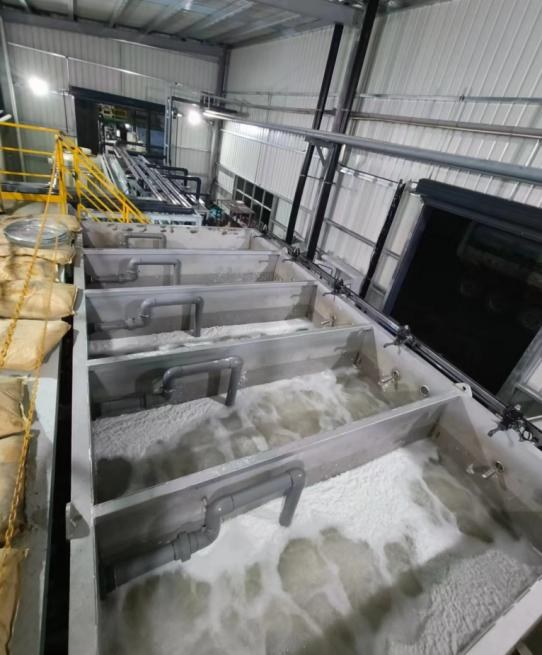
Typical values from reference installations, test data and design studies. Your proposal sets the design point and guaranteed values for your feed.
Process
A shorter path to RO feed.
Scrub UF
Conventional pressurized UF
Conventional pretreatment doses coagulant and polymer. As raw water changes, dose tends to rise, adding chloride or sulfate that concentrates in reuse loops and can load the UF, NF and RO stages. It also produces chemical sludge. Scrub UF can often pretreat RO feed without a coagulant.
| Item | Scrub UF | Conventional pressurized UF train |
|---|---|---|
| Coagulant and polymer | Often none | Required; dose tracks feed quality |
| Backwash | None | Backwash pump, tank and valves |
| Media filters | Not needed in many designs | Sand and often carbon filters |
| Chemical sludge | Less, no coagulant chemicals | Yes |
| Feed swings | Barrier tolerates turbidity swings | Dose re-tuning needed |
Reference case
Storm water to RO.
| Item | Scrub UF | Pressurized UF train |
|---|---|---|
| Pretreatment ahead of UF | Fine screen | Flocculation, clarification, sand filter, activated carbon, fine screen |
| Raw water suspended solids | 15–100 mg/L | 15–100 mg/L |
| UF filtrate suspended solids | Below 5 mg/L | Below 5 mg/L |
| Chemical cleaning interval | About 20 days | About 7 days |
| Solid waste | About 2.8 US tons/month (2.5 t) | About 8.3 US tons/month (7.5 t) |
One reference case on storm water. Results on other feeds will differ.
What RO feed to expect.
| Parameter | Typical Scrub UF permeate |
|---|---|
| SDI | Typically below 4 |
| Turbidity | Typically below 1 NTU; often below 0.1 NTU |
| Suspended solids | Typically below 5 mg/L |
| Coagulant carry-over | None where no coagulant is dosed |
| Recovery | 90% or better, depending on feed and how concentrate is discharged |
How it compares to other UF formats.
| One design study, 264,000 gpd (1,000 m³/d) | Scrub UF | Submerged hollow fiber | Pressurized UF |
|---|---|---|---|
| Pretreatment | Fine screen | Fine screen | Coagulation, flocculation, sand filter and screen |
| Design flux in the study | About 33 GFD (56 LMH) | About 24 GFD (40 LMH) | About 31 GFD (53 LMH) |
| Backwash | None | Yes | Yes, with a dedicated pump |
| Chemical clean | About every 1–2 months | Daily maintenance clean plus monthly CIP | About every 7 days |
| Specific energy | About 0.5 kWh/kgal (0.13 kWh/m³) | About 0.6 kWh/kgal (0.15 kWh/m³) | About 1.4 kWh/kgal (0.36 kWh/m³) |
| Membrane life | 5+ years | 3+ years | 3+ years |
From one engineering design study on pretreated, low-solids industrial water. Our proposals use 9–12 GFD (15–20 LMH) unless pilot data supports more. Hollow fiber can be the better choice on some very difficult feeds, so we size each job on its own water.
Packaged units
Scrub UF sizes, 861 to 11,300 ft² (80 to 1,050 m²).
| Model | Membrane area | L × W × H | Design permeate* |
|---|---|---|---|
| Scrub-UF80 | 861 ft² (80 m²) | 3'-3" × 3'-3" × 5'-11" (1,000 × 1,000 × 1,800 mm) | 5–7 gpm 7,800–10,300 gpd (29–38 m³/d) |
| Scrub-UF260-1 | 2,800 ft² (260 m²) | 3'-11" × 7'-3" × 7'-5" (1,200 × 2,200 × 2,250 mm) | 17–23 gpm 25,200–33,600 gpd (94–125 m³/d) |
| Scrub-UF350-1 | 3,770 ft² (350 m²) | 3'-11" × 7'-3" × 8'-4" (1,200 × 2,200 × 2,530 mm) | 24–31 gpm 33,900–45,200 gpd (126–168 m³/d) |
| Scrub-UF260-2 | 5,600 ft² (520 m²) | 7'-7" × 7'-3" × 7'-5" (2,300 × 2,200 × 2,250 mm) | 35–47 gpm 50,400–67,200 gpd (187–250 m³/d) |
| Scrub-UF350-3 | 11,300 ft² (1,050 m²) | 11'-0" × 7'-3" × 8'-4" (3,350 × 2,200 × 2,530 mm) | 71–94 gpm 101,700–135,600 gpd (378–504 m³/d) |
*Design permeate at 9–12 GFD (15–20 LMH), peak 15 GFD (25 LMH). On clean water, flux may run higher; we confirm that by pilot or reference data before we design to it. A 0.16 in (4.0 mm) sheet family is also available (Scrub-UF210 / UF280).
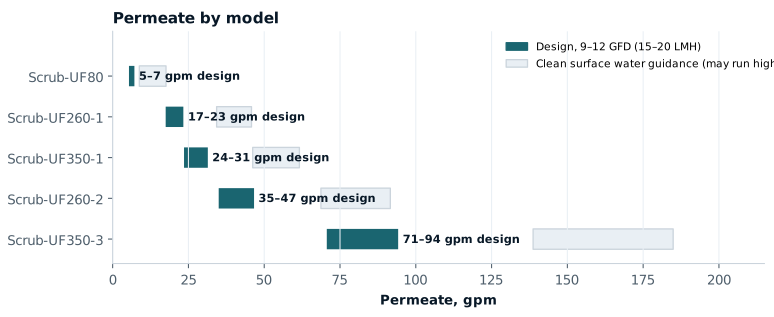
Larger plants can use a multi-cell tank, with each cell taken offline for cleaning while the others keep producing. We confirm the configuration per project. Units are assembled in Poughkeepsie, NY. Tell us your domestic-content or BABA requirements and we'll review what we can document. UF catalog Rev03 (PDF).
Questions
Common questions
Does Scrub UF need a coagulant ahead of RO?
Often not. In many designs a fine screen is the only pretreatment. Some feeds, for example where phosphorus removal is needed, still use a coagulant dose. We review your feed data first.
What SDI can I expect?
Typically below 4, which suits RO feed in many cases. We confirm the target for your feed in the proposal or by pilot.
How is it cleaned without backwash?
Screen-retained media circulates in the tank and wipes the fouling layer off the sheets while they run. A periodic tank drain removes solids, and a chemical soak is done every few weeks to months on suitable feeds.
What flux do you design to?
9–12 GFD (15–20 LMH), with 15 GFD (25 LMH) for short peaks. On clean water it may run higher; we confirm that by pilot before designing to it.
Send us your water data.
We will size Scrub UF for your flow and feed, or set up a Scrub-UF80 pilot.