Home / Products / Ceramic / Battery & hydrometallurgy
Ceramic MF/UF · lithium, battery & advanced materials
Clear brines and leach liquors. Wash fine powders without losing them.
Lithium brines, battery-recycling leach liquors and fine powder slurries all need the solids out, or the product kept in, under conditions that break polymer fibers: high salt, low pH, abrasive fines and heat. Ceramic UF and MF protect downstream NF, ion exchange and DLE media, and wash nanometer powders by diafiltration.
Send us the stream and what you need to keep. We will size ceramic against it.
What plants tell us
The problems that bring battery & hydrometallurgy plants to ceramic.
“Suspended solids foul our NF, resin and DLE media.”
Lithium brines carry clay fines and swinging suspended solids. Ceramic UF ahead of NF has handled solids up to 100 ppm, wide swings, near-freezing feed and high TDS without fiber breakage.
“Leach liquor is acidic and full of fines.”
Black-mass and ore leach liquors are strongly acidic with graphite and residue fines. PVDF UF is limited to pH 2–11. Membrane steps are central to newer metal-recovery flowsheets.
“We lose product washing fine powders.”
Nanometer powders will not settle, and centrifuges lose them. Cross-flow ceramic keeps the particles while washing water carries the dissolved salts away.
“Hot, viscous slurries tear polymer membranes.”
Hot, viscous silica sol at high velocity damages polymer UF layers. Sintered alumina UF tolerates the temperature and the erosion.
Why ceramic fits
Built for this stream.
- Unaffected by high TDS and strong acid. SiC material is stable at pH 0–14.
- Tight alumina UF retains nanometer particles for diafiltration washing and concentration.
- Abrasion-resistant against graphite, clay and oxide fines.
- Backwash and acid/caustic cleaning keep flux steady through feed swings.
- Hot operation in tubular stainless housings. 300 °F (about 150 °C) is not a problem for most ceramic and stainless steel builds.
Typical stream conditions
What we size against.
| Parameter | Typical in this industry | What it means for the membrane |
|---|---|---|
| Lithium brine | High TDS, clay fines, suspended solids swings, cold or hot | Ceramic UF/MF ahead of NF, IX or DLE |
| Leach liquor | Strong acid, dissolved Li/Ni/Co/Mn, graphite and residue fines | SiC MF for solids; housings and seals per acid |
| Powder washing | Nanometer particles plus dissolved salts | Alumina UF diafiltration |
| Silica sol | 10–60 nm colloid, hot and viscous during concentration | Alumina UF |
Ranges widely documented in industry literature. Your stream sets the design.
Projects like these
Where ceramic is already running on battery & hydrometallurgy streams.
Typical case types from ceramic membrane installations worldwide. Names, sites and sizes are withheld, and no single result carries over to your stream.
New-energy materials
Ceramic used on lithium and battery-material process streams.
Electrode and nano-powder washing
Titanium oxide, zinc oxide, alumina, barium titanate, silver and graphene powders washed by ceramic diafiltration.
Silica sol concentration
Colloidal silica concentrated with ceramic UF instead of evaporation.
Catalyst recovery
Nanometer catalyst held back and returned to the reactor.
SiC or alumina
Which ceramic for this job.
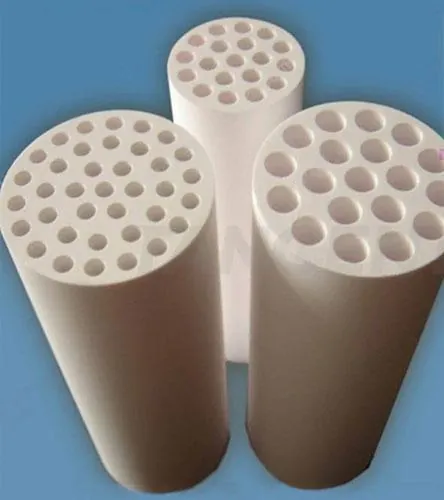
Alumina tubular for tight UF, powder washing and silica sol. SiC for abrasive, high-solids or extreme-pH leach liquors and brine clarification. The standard SiC flat-sheet module housing is rated 41–113 °F (5–45 °C).
Ceramic flux depends on the application. As a general range, expect about 6–29 GFD (10–50 LMH) for non-pressurized (submerged) systems, and up to 100 GFD (170 LMH) for pressurized systems.
Warranty against defects in materials and workmanship. For industrial applications, membrane life depends on the service duty, so we run a pilot test to establish expected system life.
Honest selection
Ceramic UF and MF separate particles and colloids. They do not select lithium from other ions; that is the job of NF, IX, DLE sorbents or solvent extraction, which ceramic protects. Each stream needs a test, so we start with a sample.
What to send
Feed first.
- Stream type and flow
- TDS, pH, temperature (°F), key metals
- Solids load and particle size
- What must be kept vs removed
- Downstream step to protect (NF, IX, DLE, SX, crystallizer)
Lab or pilot testing on a sample is available before you commit.
Built and backed in the USA.
Ceramic elements come from certified sources, and the quotation documents their origin. Zyramic supplies the modules, and frames and skids are assembled in our Poughkeepsie, NY shop.
We presently have a manufacturing facility in Poughkeepsie, New York, and the ability to ship from Europe and Asia.
On a federally funded job? Tell us your domestic-content requirements, including Build America, Buy America (BABA), and we'll review what we can document.
Zyramic, Inc.
14 Tucker Dr, Suite 4
Poughkeepsie, NY 12603
845-402-6318 · tom@zyramic.com
Related: Brine filtration · Acid streams · Mine water · All harsh industrial streams · Ceramic modules