Home / Products / Ceramic / Produced & frac water
Ceramic MF/UF · oilfield water
Produced and frac water: take the oil and solids out, keep the barrels moving.
Produced water runs about three barrels for every barrel of oil, and up to 20 in older US fields. It arrives oily, salty, hot and full of fines. Polymer membranes foul and age fast on it. Silicon carbide and alumina can be backwashed, cleaned hard and run at temperature, so the water is ready for reuse, reinjection or the next treatment step.
Send us a water analysis. We will tell you whether ceramic belongs in your train.
What plants tell us
The problems that bring produced & frac water plants to ceramic.
“The volume never stops.”
Produced water runs about 3× the oil volume, and up to 20:1 in older US reserves. Every barrel you can reuse or reinject is a barrel you do not haul or dispose of.
“Oil fouls our membranes and won’t clean off.”
Polymer UF is typically limited to 100–300 mg/L oil and grease in the feed. Most field membrane applications on produced water use ceramic because it tolerates high temperature, harsh chemicals and aggressive cleaning.
“Reinjection wells keep plugging.”
In one pilot, 100 nm ceramic MF cut oil TOC from 200–600 ppm to about 1.5 ppm, at about 90% recovery, with TDS above 100,000 ppm. Treated water held 70–80% reinjectivity, while untreated water plugged the core within a day.
“It comes out hot.”
PVDF UF is typically rated to 104 °F (40 °C). Ceramic in stainless housings runs at temperature, so you do not have to cool the water first.
“Our chemistry changes every week.”
Ceramic takes strong acid, caustic and oxidant cleaning without wearing out. Be aware that polymer from chemical EOR fouls even ceramic quickly, so test with real water.
Why ceramic fits
Built for this stream.
- 100 nm microfiltration was the best balance in a published pilot. Tighter pores fouled faster with little water-quality gain.
- Hydrophilic SiC has shown lower irreversible fouling than alumina on oil-in-water emulsions.
- Salinity does not matter to the ceramic, which handled TDS above 100,000 ppm in the pilot.
- Abrasion-resistant elements for sand and fines. Backwash and chemical cleaning restore flux.
- Ceramic modules can be rented for a trial on your own water. See rentals.
Typical stream conditions
What we size against.
| Parameter | Typical in this industry | What it means for the membrane |
|---|---|---|
| Oil | Free and emulsified; 200–600 ppm TOC from oil in one pilot feed | Above polymer UF feed limits; SiC preferred |
| TDS | Often very high; above 100,000 ppm in the pilot | Passes MF/UF; desalting is a separate step |
| Temperature | Field-dependent, often warm to hot | Tubular in stainless for hot water; flat sheet to 113 °F (45 °C) |
| Solids | Sand, fines, scale and iron | Backwashable ceramic; coarse separation first |
| EOR polymer | Present in chemical-EOR fields | Rapid fouling even on ceramic; pilot before sizing |
Ranges widely documented in industry literature. Your stream sets the design.
Projects like these
Where ceramic is already running on produced & frac water streams.
Typical case types from ceramic membrane installations worldwide. Names, sites and sizes are withheld, and no single result carries over to your stream.
Frac flowback and produced-water reuse
Ceramic installations treating frac water for reuse in US oilfields.
Oil–water separation
Emulsified oil removed from oilfield and refinery water with backwashable SiC.
Coal-chemical and high-salt streams
Ceramic MBR run on high-salt coal-chemical brine.
Mobile pilot skids
Trailer or skid pilots run on site before a permanent unit is sized.
SiC or alumina
Which ceramic for this job.
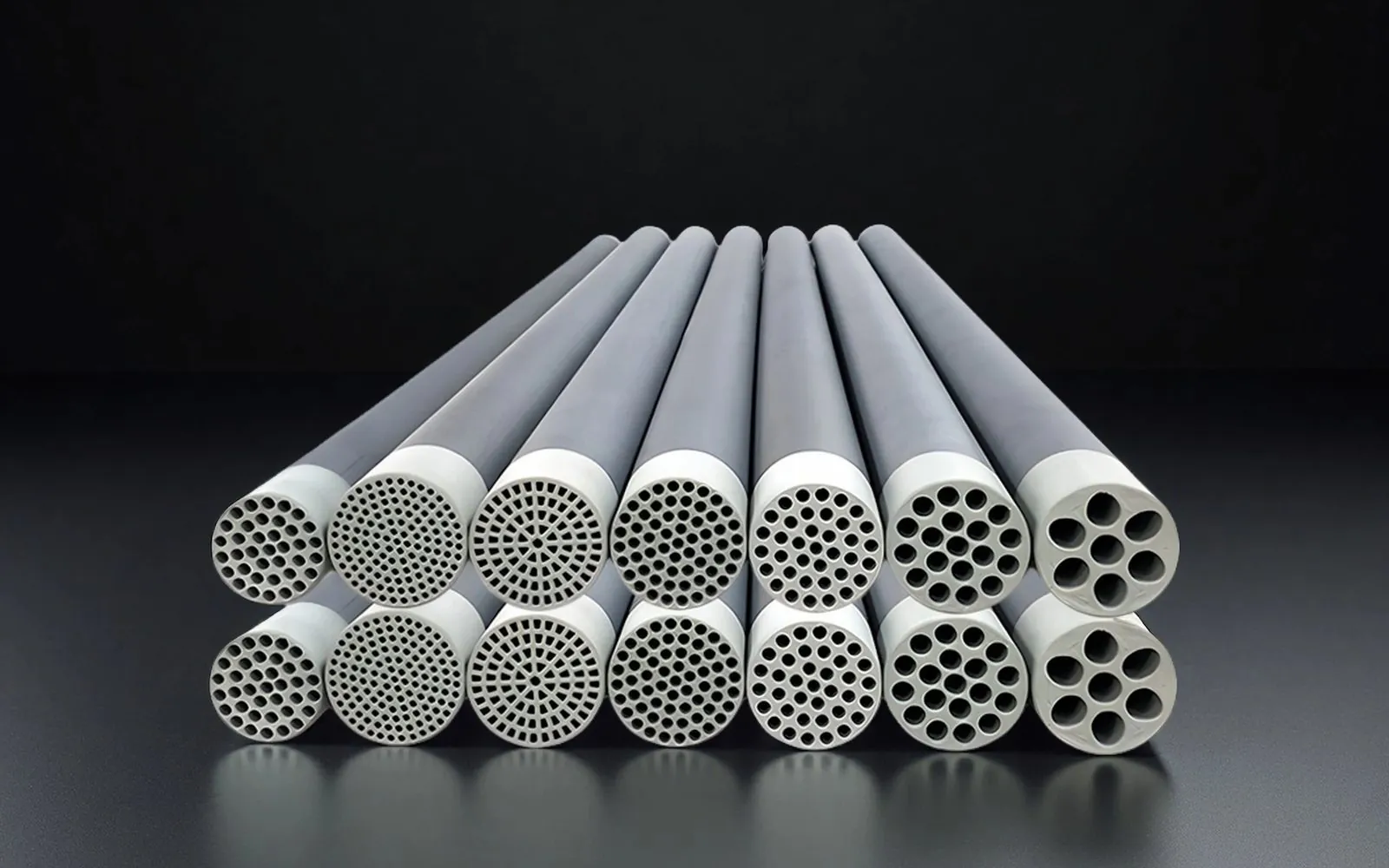
SiC for oily, high-solids water: the highest flux and the most oil-tolerant surface. Tubular SiC in stainless steel for hot or pressurized duty. SiC flat sheet in an open tank for cooler water. The standard SiC flat-sheet module housing is rated 41–113 °F (5–45 °C). Alumina when a tighter cut-off is needed.
Ceramic flux depends on the application. As a general range, expect about 6–29 GFD (10–50 LMH) for non-pressurized (submerged) systems, and up to 100 GFD (170 LMH) for pressurized systems.
Warranty against defects in materials and workmanship. For industrial applications, membrane life depends on the service duty, so we run a pilot test to establish expected system life.
Honest selection
Ceramic removes oil and solids. It does not remove salt. If the goal is discharge or beneficial reuse, plan a desalting step after it. On very clean, cool water, polymer may be enough. Chemical-EOR polymer fouls every membrane, so we want a sample or a pilot first.
What to send
Feed first.
- Barrels per day, average and peak
- Oil in water, TSS, TDS, temperature (°F)
- Iron, hardness, H₂S, any EOR polymer or friction reducer
- Destination: reuse, reinjection, disposal or desalting
- Site: permanent facility, pad or mobile
Lab or pilot testing on a sample is available before you commit.
Built and backed in the USA.
Ceramic elements come from certified sources, and the quotation documents their origin. Zyramic supplies the modules, and frames and skids are assembled in our Poughkeepsie, NY shop.
We presently have a manufacturing facility in Poughkeepsie, New York, and the ability to ship from Europe and Asia.
On a federally funded job? Tell us your domestic-content requirements, including Build America, Buy America (BABA), and we'll review what we can document.
Zyramic, Inc.
14 Tucker Dr, Suite 4
Poughkeepsie, NY 12603
845-402-6318 · tom@zyramic.com
Related: Hot oily emulsions · Brine streams · All harsh industrial streams · Ceramic modules