Home / Products / Ceramic / Metalworking & oily water
Ceramic UF · coolant, wash water, degreasing
Stop hauling water. Haul only the oil.
Spent coolant, cutting fluid, tumbling water and parts-washer rinse are mostly water. Ultrafiltration sends the water to the sewer or back to the shop, and leaves a small oily concentrate to haul. Ceramic is the version that survives hot alkaline cleaners, abrasive swarf and solvent-bearing washes.
Send us your haul-off invoices. We will estimate the volume ceramic can cut.
What plants tell us
The problems that bring metalworking & oily water plants to ceramic.
“Haul-off is our biggest waste bill.”
Ultrafiltration of spent water-based fluids has cut disposal volume by up to 90%. You pay to haul the oil, not the water.
“Our degreaser bath dies too fast.”
Ceramic membranes on alkaline degreasing baths keep the cleaner in the bath and pull the oil out, so the bath lasts longer.
“Swarf and fines wreck our membranes.”
Grinding and deburring fines are abrasive. Rigid ceramic channels and backwash handle solids that tear or plug polymer.
“Hot alkaline cleaners attack the membrane.”
PVDF is rated to about pH 11 and 104 °F (40 °C) and embrittles in strong alkali. Ceramic does not.
“The oil load is too high for submerged UF.”
Submerged polymer UF is typically limited to 100–300 mg/L oil and grease. Spent coolant is often an oil emulsion of several percent.
Why ceramic fits
Built for this stream.
- Industrial ceramic UF on cold-rolling emulsion removed 99.88% of oil and 98.41% of COD.
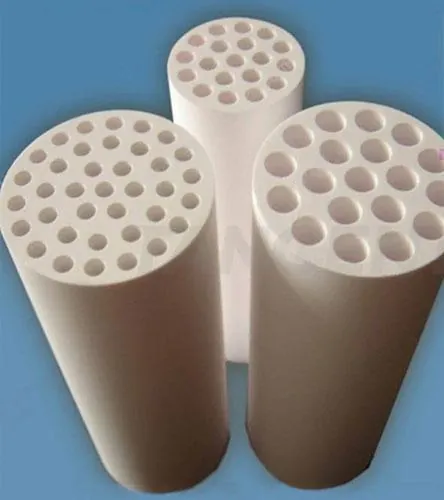
- Cross-flow tubular design handles high oil and solids and concentrates them for haul-off.
- Cleans with strong caustic, acid and solvents without losing life.
- Permeate to sewer (subject to your permit) or back to wash and make-up water.
- Works batch from a collection tank, so it fits a shop with irregular flows.
Typical stream conditions
What we size against.
| Parameter | Typical in this industry | What it means for the membrane |
|---|---|---|
| Oil | Emulsified coolant, tramp oil, cleaner oil; often far above 300 mg/L | Tubular ceramic UF concentrates it |
| Solids | Swarf, fines, deburring media | Settling or bag filter ahead; ceramic tolerates the rest |
| pH and temperature | Alkaline cleaners, often warm to hot | Ceramic stable; flat sheet limited to 113 °F (45 °C) |
| Solvents and additives | Biocides, surfactants, some solvents | Ceramic is solvent stable; seals chosen per stream |
Ranges widely documented in industry literature. Your stream sets the design.
Projects like these
Where ceramic is already running on metalworking & oily water streams.
Typical case types from ceramic membrane installations worldwide. Names, sites and sizes are withheld, and no single result carries over to your stream.
Coolant and cutting-fluid concentration
Spent fluids reduced to a small oily concentrate for haul-off.
Degreasing-bath recovery
Alkaline cleaner recycled to the bath while oil is removed.
Cold-rolling and drawing emulsions
Oil and COD removed from rolling-mill emulsion water.
Oil–water separation
SiC used on mixed shop oily water.
SiC or alumina
Which ceramic for this job.
Tubular ceramic (SiC or alumina) for cross-flow on high-oil batches. SiC flat sheet in a tank for lower-oil wash and rinse water at or below 113 °F (45 °C). The standard SiC flat-sheet module housing is rated 41–113 °F (5–45 °C).
Ceramic flux depends on the application. As a general range, expect about 6–29 GFD (10–50 LMH) for non-pressurized (submerged) systems, and up to 100 GFD (170 LMH) for pressurized systems.
Warranty against defects in materials and workmanship. For industrial applications, membrane life depends on the service duty, so we run a pilot test to establish expected system life.
Honest selection
Polymeric tubular UF is common on coolant and often costs less. Ceramic earns its price when the bath is hot and alkaline, the solids are abrasive, or solvents are present. Permeate still has to meet your sewer permit. Dissolved metals and some additives pass ultrafiltration.
What to send
Feed first.
- Gallons per week of spent fluid and wash water
- Oil content, solids, pH, temperature (°F)
- Fluid type: soluble, semi-synthetic, synthetic, cleaners
- Current haul-off cost per gallon
- Discharge permit limits
Lab or pilot testing on a sample is available before you commit.
Built and backed in the USA.
Ceramic elements come from certified sources, and the quotation documents their origin. Zyramic supplies the modules, and frames and skids are assembled in our Poughkeepsie, NY shop.
We presently have a manufacturing facility in Poughkeepsie, New York, and the ability to ship from Europe and Asia.
On a federally funded job? Tell us your domestic-content requirements, including Build America, Buy America (BABA), and we'll review what we can document.
Zyramic, Inc.
14 Tucker Dr, Suite 4
Poughkeepsie, NY 12603
845-402-6318 · tom@zyramic.com
Related: Acid & caustic recovery · Hot oily emulsions · All harsh industrial streams · Ceramic modules