
Home / Applications / Cooling tower blowdown
Cooling tower blowdown · Scrub UF
Turn cooling tower blowdown back into makeup water.
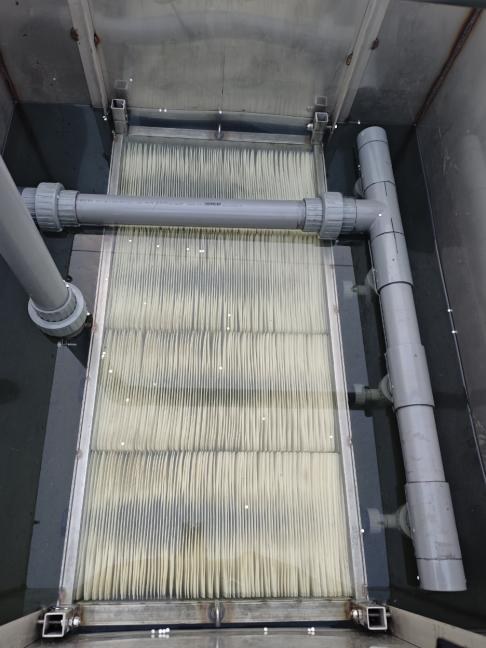
Blowdown is one of the biggest water losses at many plants. To reuse it, RO has to survive the suspended solids, colloids, biofilm and treatment chemicals in it. Scrub UF is the particle barrier ahead of the RO, in an open tank with no backwash system.
The problem
Why cooling tower blowdown projects stall.
“We’re paying for water twice.”
Blowdown carries concentrated salts, silica, hardness, treatment chemicals and suspended solids, and most of it is discharged.
“Our blowdown RO fouls in weeks.”
Particulate, organic and biological fouling, plus silica and hardness scaling, decide whether blowdown RO works. UF permeate with SDI typically below 4 removes the particle part of that load.
“Media filters can’t keep up with the swings.”
Blowdown quality moves with cycles, season and chemistry. The Scrub UF barrier holds permeate quality through turbidity swings.
“We don’t want another backwash system.”
No backwash pump, tank, valves or sequencing.
Where Scrub UF fits
Typical trains.
| Goal | Example train |
|---|---|
| Blowdown back to makeup | Blowdown → softening or silica control if needed → Scrub UF → RO → makeup |
| Side-stream solids control | Tower basin side-stream → Scrub UF → back to basin |
| Discharge-limit compliance | Blowdown → Scrub UF → discharge, when TSS is the limit |
At a glance
What the membrane does.
| Item | Scrub UF (typical) |
|---|---|
| Membrane | PVDF thin-film composite flat-sheet ultrafiltration, on PET non-woven with a PP filtrate channel, about 0.04 µm nominal pore size. Same membrane family as Swing; the difference is mechanical scrubbing rather than swing/scour cleaning |
| Fouling control | Circulating scrubbing media wipes the sheets while they run. No backwash pump, tank or cycle |
| Design flux | 9–12 GFD (15–20 LMH); peak 15 GFD (25 LMH) |
| Permeate | Turbidity typically below 1 NTU, often below 0.1 NTU; SDI typically below 4 |
| Recovery | 90% or better, depending on feed and concentrate handling |
| Chemical clean | Often every few weeks to about 1–2 months on suitable feeds |
Typical values from reference installations, test data and design studies. Your proposal sets the design point and any guaranteed values for your water.
Projects like these
Reference results on similar water.
From reference installations, tests and design studies. Names and sites are withheld. Results on other water will differ, and we confirm by pilot.
Storm water to RO
Fine screen and Scrub UF in place of flocculation, clarification, sand and carbon filters. Chemical cleaning about every 20 days vs about every 7 days.
Design study, low-solids process water
One engineering design study, about 264,000 gpd (1,000 m³/d) of pretreated low-solids industrial water: specific energy about 0.5 kWh/kgal (0.13 kWh/m³) for Scrub UF versus about 1.4 kWh/kgal (0.36 kWh/m³) for pressurized UF. Not a guarantee.
Cooling tower makeup reuse
Ultrafiltration followed by NF or RO sized to the makeup spec, one of the standard Scrub UF trains.
Packaged units
Sizes from 861 to 11,300 ft² (80 to 1,050 m²).
| Model | Membrane area | Design permeate* |
|---|---|---|
| Scrub-UF80 | 861 ft² (80 m²) | 5–7 gpm · 7,800–10,300 gpd (29–38 m³/d) |
| Scrub-UF260-1 | 2,800 ft² (260 m²) | 17–23 gpm · 25,200–33,600 gpd (94–125 m³/d) |
| Scrub-UF350-1 | 3,770 ft² (350 m²) | 24–31 gpm · 33,900–45,200 gpd (126–168 m³/d) |
| Scrub-UF260-2 | 5,600 ft² (520 m²) | 35–47 gpm · 50,400–67,200 gpd (187–250 m³/d) |
| Scrub-UF350-3 | 11,300 ft² (1,050 m²) | 71–94 gpm · 101,700–135,600 gpd (378–504 m³/d) |
*Design permeate at 9–12 GFD (15–20 LMH), peak 15 GFD (25 LMH). Larger plants use multiple units or a multi-cell tank, confirmed per project. Units are assembled in Poughkeepsie, NY.
Try it first: the Scrub-UF80 ships as a unit to buy or rent for a pilot on your own water. Rentals
Honest selection
What UF will and won’t do here.
Ultrafiltration removes particles, colloids and bacteria. It does not remove dissolved silica, hardness or salts. Those need softening, antiscalant or RO design work. Check biocides and dispersants against the PVDF membrane.
What to send
Water first.
- Blowdown flow and cycles of concentration
- TSS, turbidity, silica, hardness, conductivity, temperature (°F)
- Treatment chemicals and biocides in use
- Reuse target and RO plans
- Discharge limits and cost
Related
UF for RO pretreatment · UF for industrial water reuse · UF for industrial process water
We presently have a manufacturing facility in Poughkeepsie, New York, and the ability to ship from Europe and Asia.
Warranty against defects in materials and workmanship. For industrial applications, membrane life depends on the service duty, so we run a pilot test to establish expected system life.
Tell us your domestic-content requirements, including Build America, Buy America (BABA), and we'll review what we can document.
Zyramic, Inc.
14 Tucker Dr, Suite 4, Poughkeepsie, NY 12603
845-402-6318 · tom@zyramic.com