
What a membrane bioreactor actually does
In a conventional plant, solids settle in a clarifier and the overflow goes on to filters or disinfection. In an MBR, ultrafiltration or microfiltration membranes sit directly in the mixed liquor and pull clean water through under a slight suction. Because separation no longer depends on how well sludge settles, the biology can run at much higher mixed liquor suspended solids, often several times what a clarifier can handle. Higher MLSS means a smaller aeration basin for the same load, and the membrane barrier holds back suspended solids and most bacteria.
The trade-off is that the membrane becomes the most important piece of equipment in the plant. Its flux, how it fouls, how it is cleaned and how often it has to be replaced decide both operating cost and how much the operator has to babysit the system.
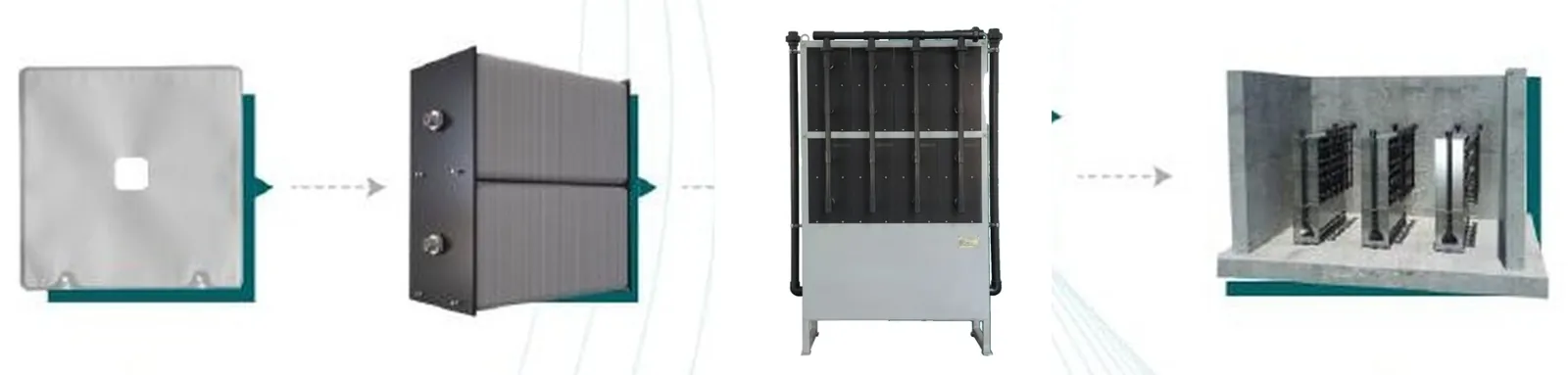
Hollow fiber, typical flat sheet and Zyramic cartridges
How the three approaches generally compare in service:
| Feature | Hollow fiber | Typical flat sheet | Zyramic cartridge (Swing) |
|---|---|---|---|
| Replacement | Whole bundle or module | Full panels or cassettes | Replace a cartridge quickly: swap one small cartridge in minutes without pulling the whole module |
| Owner maintenance | Bundle repair or replacement often needs specialist help | Panels or cassettes usually lifted as a unit | Surface servicing: sheets stay sealed in their small, cost-effective cartridge, so you swap the whole cartridge quickly, in minutes, in-house with basic tools and little downtime |
| Wear and tear | Fibers can break at the potting | Large sheets flex in service | Small sheets flex less, for less wear and tear |
| Edge seals | Potted fiber ends | Varies by design | Strong wide membrane welds, designed to resist delamination |
| Membrane | Thin fibers | Varies | Thick, about 250 microns including support, for robust service |
| Ragging | Hair can wrap fiber bundles | Open channels | Open channels between small sheets |
| Inspection | Bundle examined closely | Panel lifted to inspect | A lifted cartridge shows its condition at a glance |
| Custom sizing | Fixed module sizes | Often fixed sizes | Cartridge and module sizes tailored to your tanks in many cases |
Performance depends on pretreatment, design flux and operation.
Flat sheet versus hollow fiber
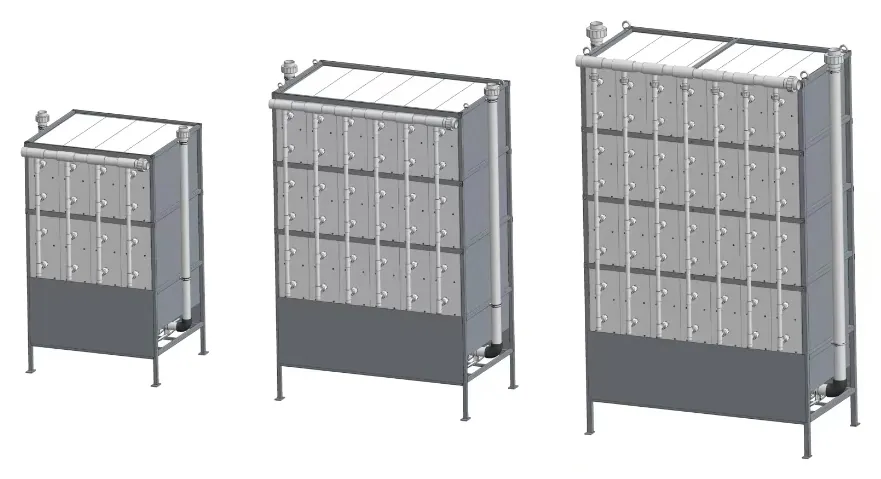
Submerged MBR membranes come in two main formats. Hollow fiber bundles pack a lot of area into a small space but can collect hair and fibrous material around the potting. Flat-sheet membranes present a smooth surface with defined channels between sheets, which many operators find more tolerant of ragging and easier to inspect. Zyramic builds flat-sheet modules: Swing MBR cartridges with dense thin-film sheets, and Palisade plates welded to solid polypropylene frames.
Where an MBR makes sense
- Tight sites or plants that must add capacity inside existing tanks
- Reuse, irrigation or sensitive-receiving-water permits with low TSS and turbidity limits
- Industrial streams with variable loads where a clarifier struggles
- Decentralized and package plants where a compact, repeatable unit is valuable
For simple, large, low-cost-land sites with relaxed limits, conventional activated sludge may still be the better answer, and we will say so.
| Mild backwash (special cases only) |
|---|
| Backwashing is not a standard Swing operating mode and is not meant for routine use. Swing has been pressure-tested to 14.5 psi (1 bar) and held without breaking. If a site is in a bind even after relaxation and CIP, contact us; we may be able to work out a special mild-backwash procedure. |
Worked sizing example
Take a small municipal plant treating an average 264,172 gpd (1,000 m³/day):
| Item | US | Metric | Note |
|---|---|---|---|
| Average flow | 264,172 gpd | 1,000 m³/day | about 183 gpm (41,667 L/h) |
| Design flux (gross) | 11.8 gfd | 20 LMH | Zyramic design guidance |
| Derate for relaxation and cleaning | ~20% | ~20% | |
| Net flux | ~9.4 gfd | ~16 LMH | |
| Membrane area needed | ~28,031 ft² | ~2,604 m² | average flow ÷ net flux |
| Swing-8 cartridges | ~209 | ~209 | 135 ft² (12.5 m²) each |
| Peak factor | ~2.0 | ~2.0 | |
| Peak flow | ~528,344 gpd | ~2,000 m³/day | extra area, short-term higher flux, or equalization |
This is an illustration only; a real design also checks temperature, MLSS, redundancy and the cleaning schedule.
Tips for a smooth project
- Size for peak hour as well as average flow
- Invest in good fine screening up front
- Use temperature-corrected flux for cold-weather design
- Plan lifting access so modules come out easily
Next step
Most projects start with a short call or an email with flows and a sketch. We send back a preliminary module layout and a quote, then refine it with your engineer once the process design is firm. If you are still comparing processes, we'll help you choose the right approach for your site.
Sizing considerations
To give a useful recommendation we usually need:
- Average, peak day and peak hour flow
- Influent BOD, TSS, TKN and temperature range
- Target effluent limits or reuse class
- Available tank dimensions for a retrofit
- Fine screening upstream (0.08 in (2 mm) or finer is commonly recommended)
Most relevant product: Swing MBR. See also replacement membranes, rentals and how to choose.
When the duty is ultrafiltration, not an MBR
An MBR keeps biology and a membrane in the same tank. Scrub UF does not. It is submerged flat-sheet ultrafiltration for water that is already low in biodegradable load, or for a physical barrier ahead of reuse. Design flux is 9–12 GFD (15–20 LMH), peak 15 GFD (25 LMH), and it may run higher on clean water. Recovery is 90% or better on suitable feeds. There is no backwash. Scrubbing media circulates in the tank and wipes the sheets while they run.
| Question | MBR (Swing or Palisade) | Scrub UF |
|---|---|---|
| What it treats | Raw or primary wastewater, with biology in the tank | Surface water, reuse water, or RO feed |
| Cleaning | Scour plus chemical clean in place | Circulating scrubbing media. No backwash. Chemical soak every few weeks to months on suitable feeds |
| Design flux | 9–12 GFD (15–20 LMH), peak 15 GFD (25 LMH) | 9–12 GFD (15–20 LMH), peak 15 GFD (25 LMH). May run higher on clean water |
| Where to read more | Swing · Palisade | Scrub UF · RO pretreatment · industrial reuse · surface water |
Figures are design guidance and reference values. Your proposal sets the design point. A multi-cell UF tank is confirmed per project. Units are assembled in Poughkeepsie, NY.
Why engineers look at Zyramic flat-sheet modules
| Item | Details |
|---|---|
| Smaller sheets, less wear and tear | each sheet flexes less in service, and a damaged unit affects less area. |
| Strong wide membrane welds | designed to resist delamination over the membrane's life. |
| Thick, robust membrane | about 250 microns including support. |
| Assembled in Poughkeepsie, NY | In our Poughkeepsie shop we build frames and assemble units. For funded projects, tell us your domestic-content requirements and we'll review what we can document. |
| Buy, rent or replace | new modules, rentals and pilots for US projects, and replacement membranes that fit many existing cassettes. |
Performance and life depend on pretreatment, design flux and operation; flux figures are Zyramic design guidance, sized to each project.
Frequently asked questions
What flux should an MBR be designed for?
Zyramic design guidance for Swing is roughly 9, 12 and 15 gfd (15, 20 and 25 LMH) for long-life, average and peak conditions, then derated about 20% to net. Actual design depends on temperature, feed and cleaning strategy, so we size each project.
How long do MBR membranes last?
Life depends on pretreatment, cleaning chemistry and operating flux. Many plants plan for replacement on a multi-year cycle; good screening and moderate flux generally extend life.
Can I rent an MBR to test it?
Yes. Every Zyramic module can be rented for US projects, including pilots on your own mixed liquor. See Rentals.
Do you sell complete treatment plants?
No. Zyramic makes membrane modules, cartridges, replacement membranes and parts, and works with engineers, integrators and package-plant builders who supply the rest of the plant.
What pretreatment does an MBR need?
Fine screening, commonly 0.08 in (2 mm) or finer, plus grit removal and FOG control where needed. Screening is the single most important protection for the membranes, and many MBR problems trace back to screens that let hair and fibers through.
What effluent quality can an MBR reach?
Well-run MBRs typically produce very low TSS and turbidity, and with the right biological design can achieve nitrogen and phosphorus removal. Actual results depend on design and operation, so permit compliance should be confirmed in the process design.