
Step 1: rule out the easy things
Verify the pressure transmitter and its zero, check that permeate valves are fully open and that the pump is not cavitating, and look for air in the permeate line. Compare TMP against flux and temperature: cold water raises viscosity, so the same flux needs more suction in winter. Calculate temperature-corrected permeability before deciding the membrane is the problem.
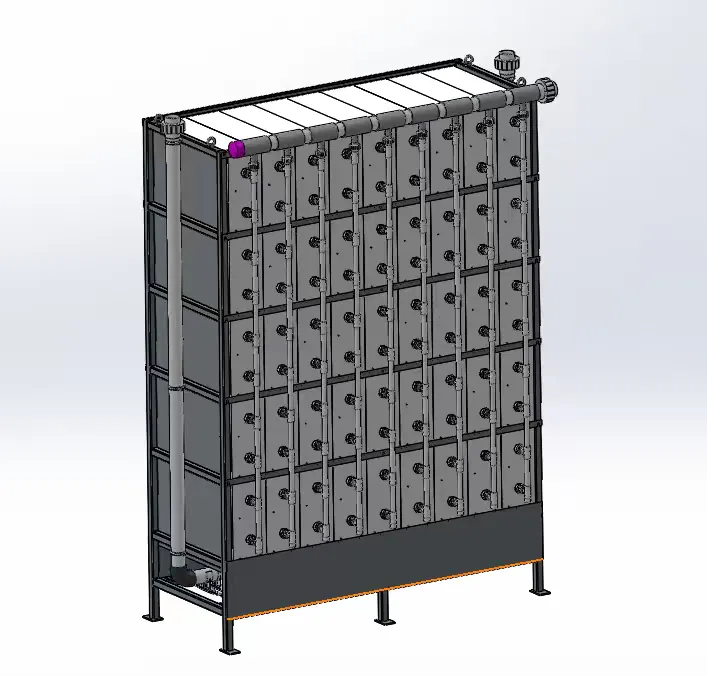
Step 2: look at the tank
Is the mixed liquor distributed evenly across the module? High MLSS, poor mixing or dead zones can let sludge pack between sheets. Hair and fibers bridging sheets are a sign that screening needs attention. Foam and viscous, gray mixed liquor often accompany biological stress.
Step 3: clean and measure recovery
A maintenance clean followed by a recovery clean should restore much of the lost permeability. If it does not, the remaining fouling is irreversible or the membranes are physically damaged. At that point, replacement membranes made to fit the existing cassette, or a retrofit, may be the practical fix. Temporary rental modules can carry flow while you decide.
Worked sizing example
Take a 105,669 gpd (400 m³/day) plant whose TMP doubles between cleans:
| Item | US | Metric | Note |
|---|---|---|---|
| Average flow | 105,669 gpd | 400 m³/day | about 73 gpm (16,667 L/h) |
| Design flux (gross) | 8.8 gfd | 15 LMH | Zyramic design guidance |
| Derate for relaxation and cleaning | ~20% | ~20% | |
| Net flux | ~7.1 gfd | ~12 LMH | |
| Membrane area needed | ~14,950 ft² | ~1,389 m² | average flow ÷ net flux |
| Swing-8 cartridges | ~112 | ~112 | 135 ft² (12.5 m²) each |
| Peak factor | ~2.0 | ~2.0 | |
| Peak flow | ~211,338 gpd | ~800 m³/day | extra area, short-term higher flux, or equalization |
This is an illustration only; a real design also checks temperature, MLSS, redundancy and the cleaning schedule.
Tips for a smooth project
- Look for the root cause before increasing cleaning strength
- Use temperature-corrected permeability when judging membranes
- Check screens for bypasses after storms
- Plan replacements ahead of permit deadlines
Next step
Membrane issues are easiest to resolve early. Send your trend data, cleaning records and a few photos, and we will give you our read on whether to focus on pretreatment, biology, operation or the membranes themselves, and a sensible next step, whether that is a change in procedure, a partial replacement or interim capacity.
Sizing considerations
To give a useful recommendation we usually need:
- TMP, flux and temperature trend data
- Recent changes in load, MLSS or chemicals
- Results of the last recovery clean
- Screen condition
- Age of the membranes
Most relevant product: Replacement membranes. See also replacement membranes, rentals and how to choose.
Why engineers look at Zyramic flat-sheet modules
| Item | Details |
|---|---|
| Smaller sheets, less wear and tear | each sheet flexes less in service, and a damaged unit affects less area. |
| Strong wide membrane welds | designed to resist delamination over the membrane's life. |
| Thick, robust membrane | about 250 microns including support. |
| Assembled in Poughkeepsie, NY | of domestic and imported components. In our Poughkeepsie shop we cut and weld membrane sheets to plates, build module frames and assemble complete modules. For funded projects, tell us your domestic-content requirements and we'll review what we can document. |
| Buy, rent or replace | new modules, rentals and pilots for US projects, and replacement membranes that fit many existing cassettes. |
Performance and life depend on pretreatment, design flux and operation; flux figures are Zyramic design guidance, sized to each project.
Frequently asked questions
What TMP is too high?
It depends on the membrane and the manufacturer's limit. Rate of rise is often a better warning than an absolute number.
Should I just lower the flux?
Lowering flux buys time but reduces capacity. Find the cause first.
Can you supply membranes for a cassette from another brand?
We cut and weld flat-sheet plates to fit many existing cassettes. Send dimensions, port style and quantity.
Can you help remotely?
Yes, send your trend data and photos with a quote request.
Why does TMP rise faster after a clean?
If TMP climbs quickly after cleaning, the cause is often in the tank: high MLSS, poor distribution or biology problems rather than residual fouling.
Should I run a recovery clean right away?
Check instruments and hydraulics first. Unnecessary recovery cleans use chemicals and add wear.