Why plants consider switching
Common reasons include persistent ragging in fiber bundles, frequent fiber breaks and pinning, limited sources for replacement modules, and a wish for easier inspection. Flat sheet does not fix poor screening, but it is generally more forgiving and easier to see into.
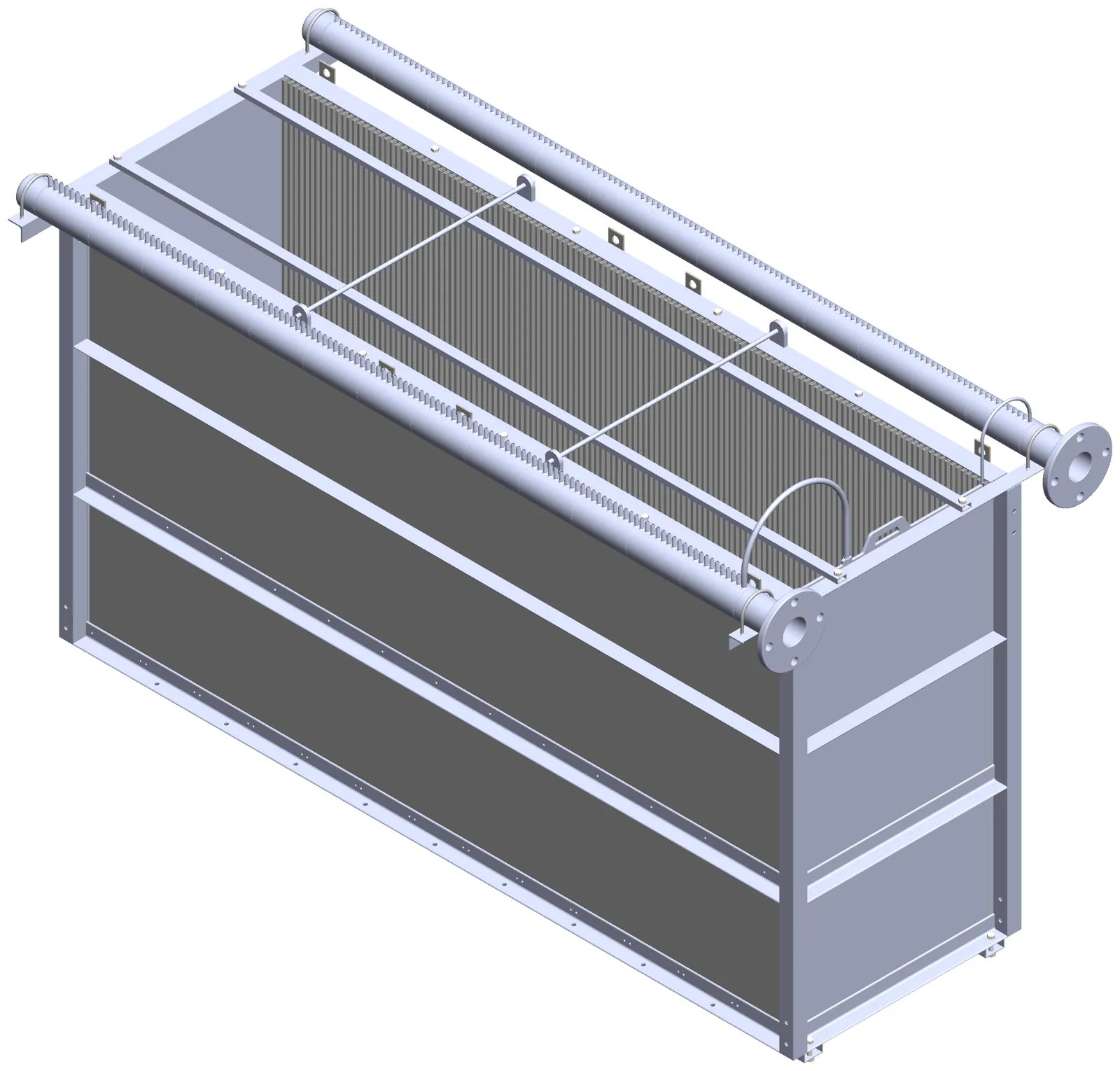
Hollow fiber, typical flat sheet and Zyramic cartridges
How the three approaches generally compare in service:
| Feature | Hollow fiber | Typical flat sheet | Zyramic cartridge (Swing) |
|---|---|---|---|
| Replacement | Whole bundle or module | Full panels or cassettes | Replace a cartridge quickly: swap one small cartridge in minutes without pulling the whole module |
| Owner maintenance | Bundle repair or replacement often needs specialist help | Panels or cassettes usually lifted as a unit | Surface servicing: sheets stay sealed in their small, cost-effective cartridge, so you swap the whole cartridge quickly, in minutes, in-house with basic tools and little downtime |
| Wear and tear | Fibers can break at the potting | Large sheets flex in service | Small sheets flex less, for less wear and tear |
| Edge seals | Potted fiber ends | Varies by design | Strong wide membrane welds, designed to resist delamination |
| Membrane | Thin fibers | Varies | Thick, about 250 microns including support, for robust service |
| Ragging | Hair can wrap fiber bundles | Open channels | Open channels between small sheets |
| Inspection | Bundle examined closely | Panel lifted to inspect | A lifted cartridge shows its condition at a glance |
| Custom sizing | Fixed module sizes | Often fixed sizes | Cartridge and module sizes tailored to your tanks in many cases |
Performance depends on pretreatment, design flux and operation.
Custom sizing: we cut, weld and assemble in Poughkeepsie, NY, so cartridge and module sizes can often be tailored to your existing tanks. Tell us your tank dimensions, or see custom sizes.
What to check
- Tank dimensions, water depth and module spacing
- Permeate header connections and pump capacity
- Air supply connections and blower capacity
- Cleaning system compatibility (flat sheet is not pressure-backwashed)
- Controls changes for relaxation and cleaning sequences
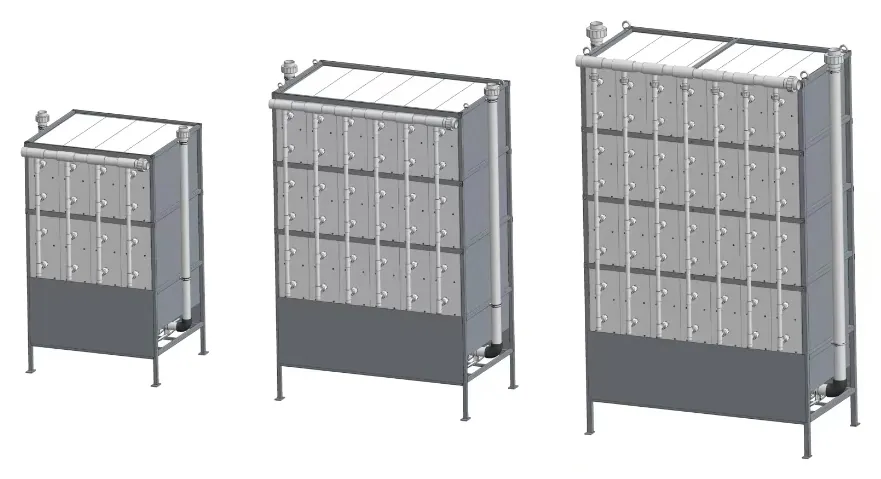
Phased retrofits
Most plants convert one train at a time to keep treating. US plants can bridge with rental modules. See flat sheet vs hollow fiber and compare for more.
| Mild backwash (special cases only) |
|---|
| Backwashing is not a standard Swing operating mode and is not meant for routine use. Swing has been pressure-tested to 14.5 psi (1 bar) and held without breaking. If a site is in a bind even after relaxation and CIP, contact us; we may be able to work out a special mild-backwash procedure. |
Worked sizing example
Take a 396,258 gpd (1,500 m³/day) hollow-fiber plant converting one train at a time:
| Item | US | Metric | Note |
|---|---|---|---|
| Average flow | 396,258 gpd | 1,500 m³/day | about 275 gpm (62,500 L/h) |
| Design flux (gross) | 11.8 gfd | 20 LMH | Zyramic design guidance |
| Derate for relaxation and cleaning | ~20% | ~20% | |
| Net flux | ~9.4 gfd | ~16 LMH | |
| Membrane area needed | ~42,046 ft² | ~3,906 m² | average flow ÷ net flux |
| Swing-8 cartridges | ~313 | ~313 | 135 ft² (12.5 m²) each |
| Peak factor | ~2.0 | ~2.0 | |
| Peak flow | ~792,516 gpd | ~3,000 m³/day | extra area, short-term higher flux, or equalization |
This is an illustration only; a real design also checks temperature, MLSS, redundancy and the cleaning schedule.
Tips for a smooth project
- Compare modules on lifecycle, not area alone
- Plan how replacement parts will be sourced later
- Allow room for handling and inspection
- Check cassette dimensions before ordering replacements
Next step
A good way to see which design choices matter most for your plant is to look at your own maintenance history. Tell us what has needed attention in the past, and we will explain which of our options fits it best.
Sizing considerations
To give a useful recommendation we usually need:
- Tank drawings and existing module layout
- Current membrane model and age
- Blower and permeate pump data
- Cleaning system details
- Number of trains
Most relevant product: Swing MBR. See also replacement membranes, rentals and how to choose.
Why engineers look at Zyramic flat-sheet modules
| Item | Details |
|---|---|
| Smaller sheets, less wear and tear | each sheet flexes less in service, and a damaged unit affects less area. |
| Strong wide membrane welds | designed to resist delamination over the membrane's life. |
| Thick, robust membrane | about 250 microns including support. |
| Assembled in Poughkeepsie, NY | of domestic and imported components. In our Poughkeepsie shop we cut and weld membrane sheets to plates, build module frames and assemble complete modules. For funded projects, tell us your domestic-content requirements and we'll review what we can document. |
| Buy, rent or replace | new modules, rentals and pilots for US projects, and replacement membranes that fit many existing cassettes. |
Performance and life depend on pretreatment, design flux and operation; flux figures are Zyramic design guidance, sized to each project.
Frequently asked questions
Is the swap really one-for-one?
Often, but not always. A drawing review confirms fit.
Can I keep my blowers and pumps?
Often, subject to capacity checks.
How long does a train conversion take?
It depends on the site; we help plan sequencing.
Do you replace other-brand hollow fiber modules directly?
We offer flat-sheet alternatives, not replica hollow-fiber modules.
Will capacity change after retrofit?
It depends on the area installed and design flux; we can match or exceed current area in many tanks.
Is the retrofit reversible?
Technically yes, but plants rarely switch back.