
Why it happens
Most ragging starts upstream. Screens with openings that are too large, bypasses during high flow, worn brushes or seals, and gaps around screen frames all let fibers into the membrane tank. Flushable wipes have made the problem worse at many plants. Sludging usually follows high MLSS, poor mixing in the membrane zone, or long periods without relaxation, and it can be accelerated by ragging that blocks flow paths.
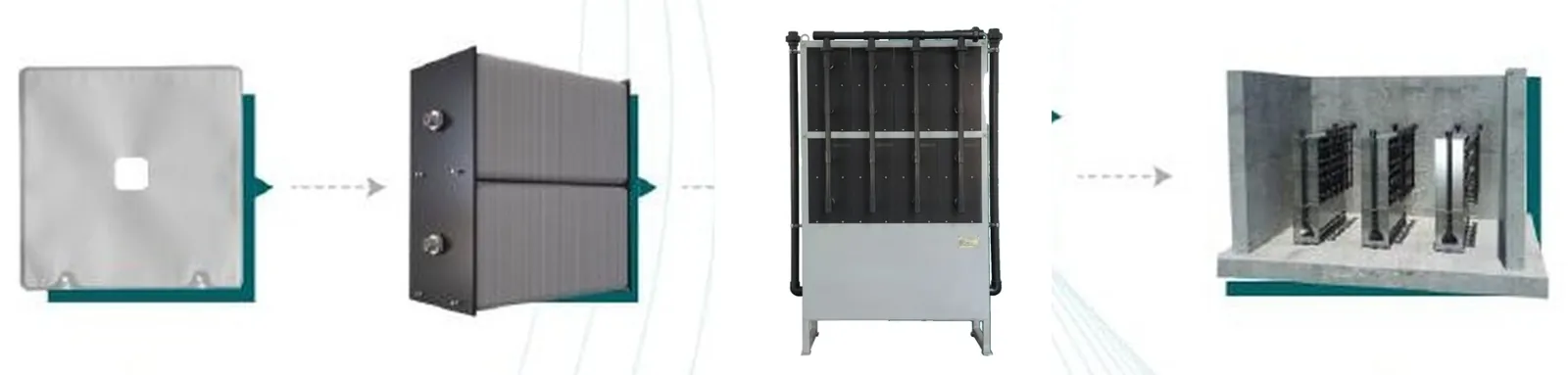
Hollow fiber, typical flat sheet and Zyramic cartridges
How the three approaches generally compare in service:
| Feature | Hollow fiber | Typical flat sheet | Zyramic cartridge (Swing) |
|---|---|---|---|
| Replacement | Whole bundle or module | Full panels or cassettes | Replace a cartridge quickly: swap one small cartridge in minutes without pulling the whole module |
| Owner maintenance | Bundle repair or replacement often needs specialist help | Panels or cassettes usually lifted as a unit | Surface servicing: sheets stay sealed in their small, cost-effective cartridge, so you swap the whole cartridge quickly, in minutes, in-house with basic tools and little downtime |
| Wear and tear | Fibers can break at the potting | Large sheets flex in service | Small sheets flex less, for less wear and tear |
| Edge seals | Potted fiber ends | Varies by design | Strong wide membrane welds, designed to resist delamination |
| Membrane | Thin fibers | Varies | Thick, about 250 microns including support, for robust service |
| Ragging | Hair can wrap fiber bundles | Open channels | Open channels between small sheets |
| Inspection | Bundle examined closely | Panel lifted to inspect | A lifted cartridge shows its condition at a glance |
| Custom sizing | Fixed module sizes | Often fixed sizes | Cartridge and module sizes tailored to your tanks in many cases |
Performance depends on pretreatment, design flux and operation.
Prevention
- Use fine screening, commonly 0.08 in (2 mm) or finer, with no bypass to the membrane tank
- Inspect screen seals and brushes regularly
- Keep MLSS within the membrane design range
- Check mixing and distribution across the module
- Plan regular visual inspections by lifting a cartridge or module
Why flat sheet helps
Flat-sheet membranes have open, defined channels and no fiber bundle for hair to wrap around, so many operators find them easier to inspect and hose down. Swing cartridges lift out individually, which makes routine inspections faster. Smaller sheets also have less unsupported area to flex. See flat sheet vs hollow fiber and cartridge replacement.
| Mild backwash (special cases only) |
|---|
| Backwashing is not a standard Swing operating mode and is not meant for routine use. Swing has been pressure-tested to 14.5 psi (1 bar) and held without breaking. If a site is in a bind even after relaxation and CIP, contact us; we may be able to work out a special mild-backwash procedure. |
Worked sizing example
Take a 184,920 gpd (700 m³/day) plant replacing membranes after a ragging event:
| Item | US | Metric | Note |
|---|---|---|---|
| Average flow | 184,920 gpd | 700 m³/day | about 128 gpm (29,167 L/h) |
| Design flux (gross) | 11.8 gfd | 20 LMH | Zyramic design guidance |
| Derate for relaxation and cleaning | ~20% | ~20% | |
| Net flux | ~9.4 gfd | ~16 LMH | |
| Membrane area needed | ~19,622 ft² | ~1,823 m² | average flow ÷ net flux |
| Swing-8 cartridges | ~146 | ~146 | 135 ft² (12.5 m²) each |
| Peak factor | ~2.0 | ~2.0 | |
| Peak flow | ~369,841 gpd | ~1,400 m³/day | extra area, short-term higher flux, or equalization |
This is an illustration only; a real design also checks temperature, MLSS, redundancy and the cleaning schedule.
Tips for a smooth project
- Look for the root cause before increasing cleaning strength
- Use temperature-corrected permeability when judging membranes
- Check screens for bypasses after storms
- Plan replacements ahead of permit deadlines
Next step
Membrane issues are easiest to resolve early. Send your trend data, cleaning records and a few photos, and we will give you our read on whether to focus on pretreatment, biology, operation or the membranes themselves, and a sensible next step, whether that is a change in procedure, a partial replacement or interim capacity.
Sizing considerations
To give a useful recommendation we usually need:
- Screen type, opening size and bypass arrangement
- Photos of ragged or sludged modules
- MLSS in the membrane tank
- Inspection frequency
- Membrane type currently installed
Most relevant product: Swing MBR. See also replacement membranes, rentals and how to choose.
Why engineers look at Zyramic flat-sheet modules
| Item | Details |
|---|---|
| Smaller sheets, less wear and tear | each sheet flexes less in service, and a damaged unit affects less area. |
| Strong wide membrane welds | designed to resist delamination over the membrane's life. |
| Thick, robust membrane | about 250 microns including support. |
| Assembled in Poughkeepsie, NY | of domestic and imported components. In our Poughkeepsie shop we cut and weld membrane sheets to plates, build module frames and assemble complete modules. For funded projects, tell us your domestic-content requirements and we'll review what we can document. |
| Buy, rent or replace | new modules, rentals and pilots for US projects, and replacement membranes that fit many existing cassettes. |
Performance and life depend on pretreatment, design flux and operation; flux figures are Zyramic design guidance, sized to each project.
Frequently asked questions
Can ragged membranes be saved?
If sheets are not torn, careful manual cleaning followed by a chemical clean often recovers them. Torn sheets need replacement.
What screen size do MBRs need?
Many manufacturers recommend 0.08 in (2 mm) or finer, ideally a mesh or perforated design. We will review your screening.
Is flat sheet immune to ragging?
No, but it is generally easier to inspect and clear.
Can I swap a hollow-fiber system to flat sheet?
Often, yes; see our retrofit page.
How often should membranes be inspected?
Many plants lift a cartridge or module on a regular schedule, for example monthly or quarterly. More frequent checks make sense after storms or screen problems.
Do flushable wipes really cause problems?
Yes, they are a major source of ragging at many plants and break down slowly.