
Stream characteristics
Dye houses discharge color, salts and auxiliaries; laundries discharge lint, detergents, oils and sometimes high temperature. Both can foam heavily and change through the day.
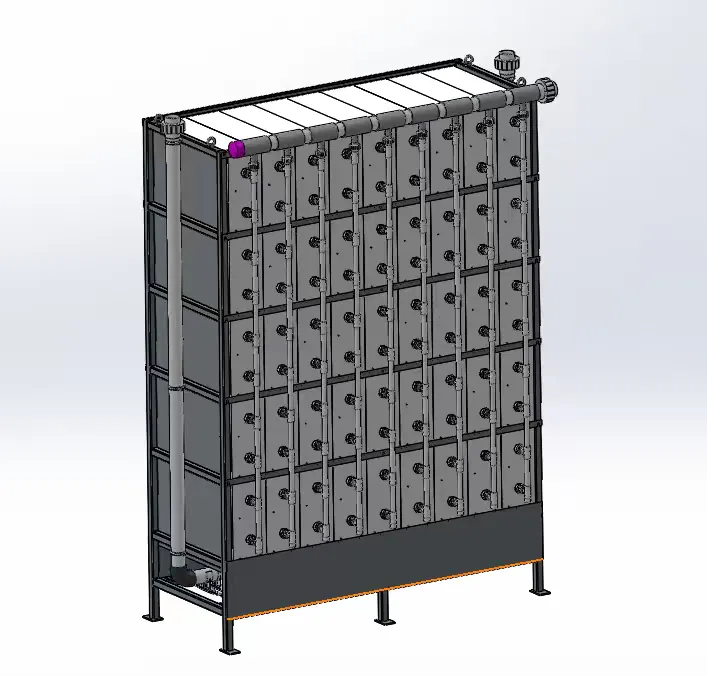
Treatment approach
Lint screening, cooling, equalization and pH control come first. An MBR removes biodegradable organics and suspended solids; color often needs further treatment such as oxidation, adsorption or nanofiltration. Low-solids MBR filtrate is a good RO feed for reuse.
Membrane selection
Lint is a ragging risk, so fine screening is critical, and flat-sheet membranes are generally easier to inspect and clear. Palisade plates and Swing cartridges both fit; hot streams may suit ceramic. See ragging.
What operators look for
Operators at a textile mill usually want the same things: effluent that consistently meets discharge or reuse limits, solids separation that does not depend on how well sludge settles, and predictable sewer charges. The feed usually carries dyes, sizing agents, surfactants and lint, and the system has to cope with high temperature, color and salt from dyeing batches. With membranes, they also look for durable sheets, easy inspection and replacement on a schedule they can plan.
- Consistent, permit-ready effluent
- Manageable cleaning routines
- Planned, predictable membrane replacement
- A compact footprint
How flat-sheet MBR can help
A membrane bioreactor replaces the clarifier with a physical barrier, so effluent quality depends far less on how well the sludge settles. That can make a textile mill system more forgiving of high temperature, color and salt from dyeing batches. Flat-sheet modules are generally easy to inspect, clean in place and handle without special tools.
Zyramic modules are built around three durability choices. Smaller membrane sheets flex less in service, which can mean less wear, and a damaged sheet takes less area out of service. Strong wide membrane welds are designed to resist delamination. A thick membrane, about 250 microns including support, is meant to stand up to solids and handling. Actual life and flux depend on pretreatment, design and operation, so we size each project individually.
More questions owners ask
Is an MBR hard to run at a textile mill?
Most operators find a well-designed MBR manageable with routine checks and periodic cleaning. Good screening and equalization upstream make the biggest difference.
Can we try it before committing?
For US projects, rental and pilot modules may be available so you can test on your own wastewater.
Can your membranes go into our existing tank?
Often, yes. Replacement flat-sheet membranes fit many existing cassettes; send us drawings and we will check fit.
Worked sizing example
Take an industrial laundry discharging 66,043 gpd (250 m³/day):
| Item | US | Metric | Note |
|---|---|---|---|
| Average flow | 66,043 gpd | 250 m³/day | about 46 gpm (10,417 L/h) |
| Design flux (gross) | 8.8 gfd | 15 LMH | Zyramic design guidance |
| Derate for relaxation and cleaning | ~20% | ~20% | |
| Net flux | ~7.1 gfd | ~12 LMH | |
| Membrane area needed | ~9,344 ft² | ~868 m² | average flow ÷ net flux |
| Swing-8 cartridges | ~70 | ~70 | 135 ft² (12.5 m²) each |
| Peak factor | ~1.5 | ~1.5 | |
| Peak flow | ~99,065 gpd | ~375 m³/day | extra area, short-term higher flux, or equalization |
This is an illustration only; a real design also checks temperature, MLSS, redundancy and the cleaning schedule.
Tips for a smooth project
- Plan for peaks from batch and cleaning discharges
- Size equalization and pH control generously
- Keep fats, lint and solids upstream of the membrane tank
- Use pilot data to choose design flux
Next step
Industrial and special-purpose plants vary widely, so every first conversation starts with fact-finding. A few weeks of flow and lab data, even rough, makes our recommendation far more reliable. Where questions remain, a pilot or a measured first phase is a good way forward.
Sizing considerations
To give a useful recommendation we usually need:
- Daily volume and temperature
- COD, color, TDS and surfactants
- Lint load and screening
- Reuse targets
- Space
Most relevant product: Palisade MBR. See also replacement membranes, rentals and how to choose.
Why engineers look at Zyramic flat-sheet modules
| Item | Details |
|---|---|
| Smaller sheets, less wear and tear | each sheet flexes less in service, and a damaged unit affects less area. |
| Strong wide membrane welds | designed to resist delamination over the membrane's life. |
| Thick, robust membrane | about 250 microns including support. |
| Assembled in Poughkeepsie, NY | of domestic and imported components. In our Poughkeepsie shop we cut and weld membrane sheets to plates, build module frames and assemble complete modules. For funded projects, tell us your domestic-content requirements and we'll review what we can document. |
| Buy, rent or replace | new modules, rentals and pilots for US projects, and replacement membranes that fit many existing cassettes. |
Performance and life depend on pretreatment, design flux and operation; flux figures are Zyramic design guidance, sized to each project.
Frequently asked questions
Does MBR remove color?
Partly; further treatment is often needed for strong color.
Will lint clog the membranes?
Without fine screening it can; screening is essential.
Can water be reused?
MBR plus RO is a common reuse route.
Can we pilot?
Yes, US sites can rent modules.
Does heat harm membranes?
Polymeric membranes have temperature limits; cooling or ceramic membranes may be needed for hot streams.
What about foaming?
Surfactants cause foam; antifoam and good tank design help.