
The core difference
An MBBR grows biofilm on plastic carriers that move freely in the tank. It is a biological process; solids still have to be separated afterward, usually with a clarifier, DAF or filter. An MBR is primarily a separation step: membranes replace the clarifier and hold back suspended solids, so the biology can run at high MLSS. That is why the effluent from an MBR is usually much lower in TSS and turbidity than from an MBBR followed by a clarifier.
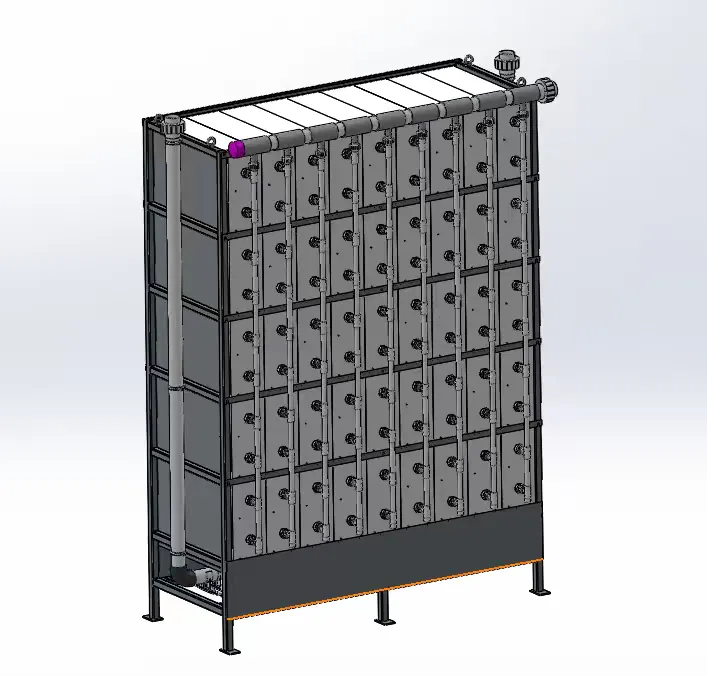
How they compare in practice
| Item | Details |
|---|---|
| Effluent | MBR typically produces reuse-grade filtrate; MBBR quality depends on the downstream separation step. |
| Footprint | both are compact; MBR also removes the clarifier. |
| Operation | MBBR is simple and tolerant of shock loads; MBR adds membrane cleaning and screening tasks. |
| Energy | MBR uses energy to keep membranes clean; MBBR uses energy for mixing and aeration of carriers. |
| Expansion | MBBR adds carrier fill; MBR adds membrane area. |
The hybrid: MBBR ahead of MBR
Some plants put an MBBR stage in front of a membrane tank, using the biofilm to handle shock loads and nitrification while the membrane delivers final quality. If you already run an MBBR and need better effluent, adding a membrane stage can be a practical upgrade. Talk to us about fitting Swing or Palisade modules downstream.
| Mild backwash (special cases only) |
|---|
| Backwashing is not a standard Swing operating mode and is not meant for routine use. Swing has been pressure-tested to 14.5 psi (1 bar) and held without breaking. If a site is in a bind even after relaxation and CIP, contact us; we may be able to work out a special mild-backwash procedure. |
Worked sizing example
Take an existing MBBR plant at 211,338 gpd (800 m³/day) adding a membrane stage:
| Item | US | Metric | Note |
|---|---|---|---|
| Average flow | 211,338 gpd | 800 m³/day | about 147 gpm (33,333 L/h) |
| Design flux (gross) | 11.8 gfd | 20 LMH | Zyramic design guidance |
| Derate for relaxation and cleaning | ~20% | ~20% | |
| Net flux | ~9.4 gfd | ~16 LMH | |
| Membrane area needed | ~22,425 ft² | ~2,083 m² | average flow ÷ net flux |
| Swing-8 cartridges | ~167 | ~167 | 135 ft² (12.5 m²) each |
| Peak factor | ~1.8 | ~1.8 | |
| Peak flow | ~380,408 gpd | ~1,440 m³/day | extra area, short-term higher flux, or equalization |
This is an illustration only; a real design also checks temperature, MLSS, redundancy and the cleaning schedule.
Tips for a smooth project
- Size for peak hour as well as average flow
- Invest in good fine screening up front
- Use temperature-corrected flux for cold-weather design
- Plan lifting access so modules come out easily
Next step
Most projects start with a short call or an email with flows and a sketch. We send back a preliminary module layout and a quote, then refine it with your engineer once the process design is firm. If you are still comparing processes, we'll help you choose the right approach for your site.
Sizing considerations
To give a useful recommendation we usually need:
- Required effluent TSS, turbidity and nutrient limits
- Reuse goals
- Shock-load and toxicity history
- Available operator time
- Existing process and tank layout
Most relevant product: Swing MBR. See also replacement membranes, rentals and how to choose.
Why engineers look at Zyramic flat-sheet modules
| Item | Details |
|---|---|
| Smaller sheets, less wear and tear | each sheet flexes less in service, and a damaged unit affects less area. |
| Strong wide membrane welds | designed to resist delamination over the membrane's life. |
| Thick, robust membrane | about 250 microns including support. |
| Assembled in Poughkeepsie, NY | of domestic and imported components. In our Poughkeepsie shop we cut and weld membrane sheets to plates, build module frames and assemble complete modules. For funded projects, tell us your domestic-content requirements and we'll review what we can document. |
| Buy, rent or replace | new modules, rentals and pilots for US projects, and replacement membranes that fit many existing cassettes. |
Performance and life depend on pretreatment, design flux and operation; flux figures are Zyramic design guidance, sized to each project.
Frequently asked questions
Is MBR better than MBBR?
Neither is universally better. MBR wins where effluent quality and footprint matter most; MBBR is often simpler where a clarifier or DAF can meet the limits.
Can I convert an MBBR plant to MBR?
Often by adding a membrane tank or replacing the clarifier with membranes. We can review the layout.
Which uses more energy?
It depends on design. MBR generally needs more energy per volume, but may avoid tertiary filtration.
Do you sell MBBR media?
No, Zyramic focuses on membrane modules.
Which is better for nutrient removal?
Both can be designed for nitrogen removal. MBR's high MLSS and long sludge age suit nitrification; MBBR handles it on biofilm. Phosphorus limits often need chemical addition with either.
Which handles toxic shocks better?
Biofilm on MBBR carriers often recovers faster from short shocks. An MBBR stage ahead of an MBR combines that resilience with membrane-quality effluent.