
Plate vs thin film at a glance
A quick summary of the two flat-sheet styles as Zyramic builds them.
| Feature | Thin film (Swing) | Plate (Palisade) |
|---|---|---|
| Construction / support | Flexible PVDF or PVDF + graphene thin-film composite sheets in small cartridges | PES membrane welded onto a solid polypropylene plate |
| Element thickness | About 0.028 in (0.7 mm) overall | About 0.31 in (8 mm) overall |
| Spacing | Sheets installed at 0.16 or 0.31 in (4 or 8 mm) centers | Set by plate thickness and module design |
| Weight | Light cartridges that a small crew can handle | Heavier, rigid plates and frames |
| Packing density | High: thin elements fit many more sheets, and more membrane area, in the same tank | Moderate |
| Format | 135 ft² (12.5 m²) cartridges in decks × columns, up to about 11,900 ft² (1,104 m²) per module | 130 or 260 plates, about 1,470 / 2,940 ft² (136.5 / 273 m²) per module |
| Cartridge / plate replacement speed | Replace a cartridge quickly: swap one cartridge in minutes without pulling the whole module | Individual plates slide out of slotted guides and are replaced on site |
| Owner maintenance | Surface servicing: sheets stay sealed in their small, cost-effective cartridge, so you swap the whole cartridge quickly, in minutes, in-house with basic tools and little downtime | Plates slide out of slotted guides after releasing a simple hold-down plate or bar, and connect with silicone tubing on hose barbs, so owners can remove, replace and clean plates on site. Plates can be heavy, so plan for handling |
| Cleaning | Relaxation and reverse-flow CIP | CIP |
| Welds | Strong wide membrane welds on small sheets | Strong wide membrane welds on rigid plates |
| Membrane thickness | Thick, about 250 microns including support | Robust plate-supported membrane |
| Custom sizing | Cartridge count, decks and frame height tailored in many cases | Plate count and frame tailored in many cases |
| Retrofit fit | Compact modules often fit existing tanks one-for-one | Suits tanks with room for plate modules |
| Pore size | 0.04 µm UF, 0.4 µm MF available | 0.04 µm standard, 0.4 µm optional |
Results depend on pretreatment, design flux and operation.
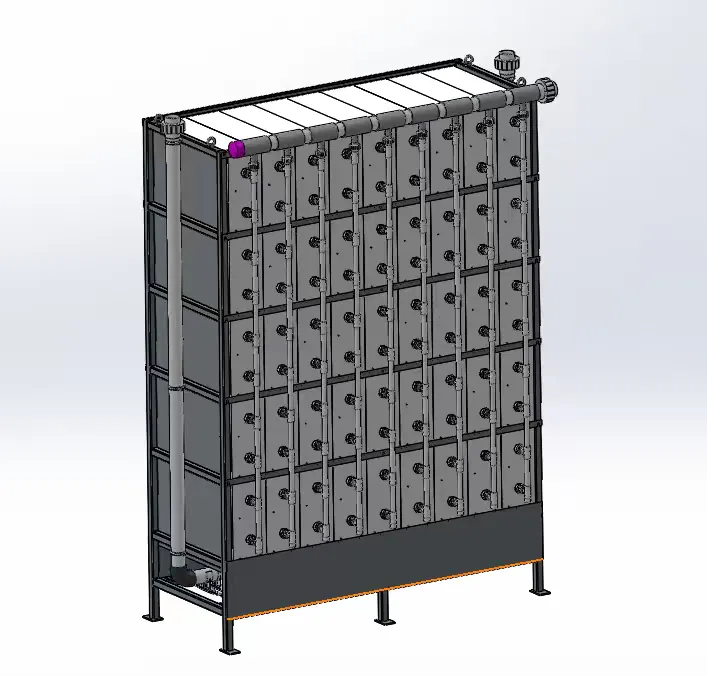
Construction and handling
Thin film packs flexible sheets densely into small cartridges. Each thin-film element is about 0.028 in (0.7 mm) thick overall, compared with about 0.31 in (8 mm) for a plate, so many more elements, and much more membrane area, fit in the same tank. Each cartridge is also light to handle. Plate membranes are welded onto rigid plates, which gives a stiff, self-supporting element. Both use strong wide membrane welds, welded in our Poughkeepsie, NY shop.
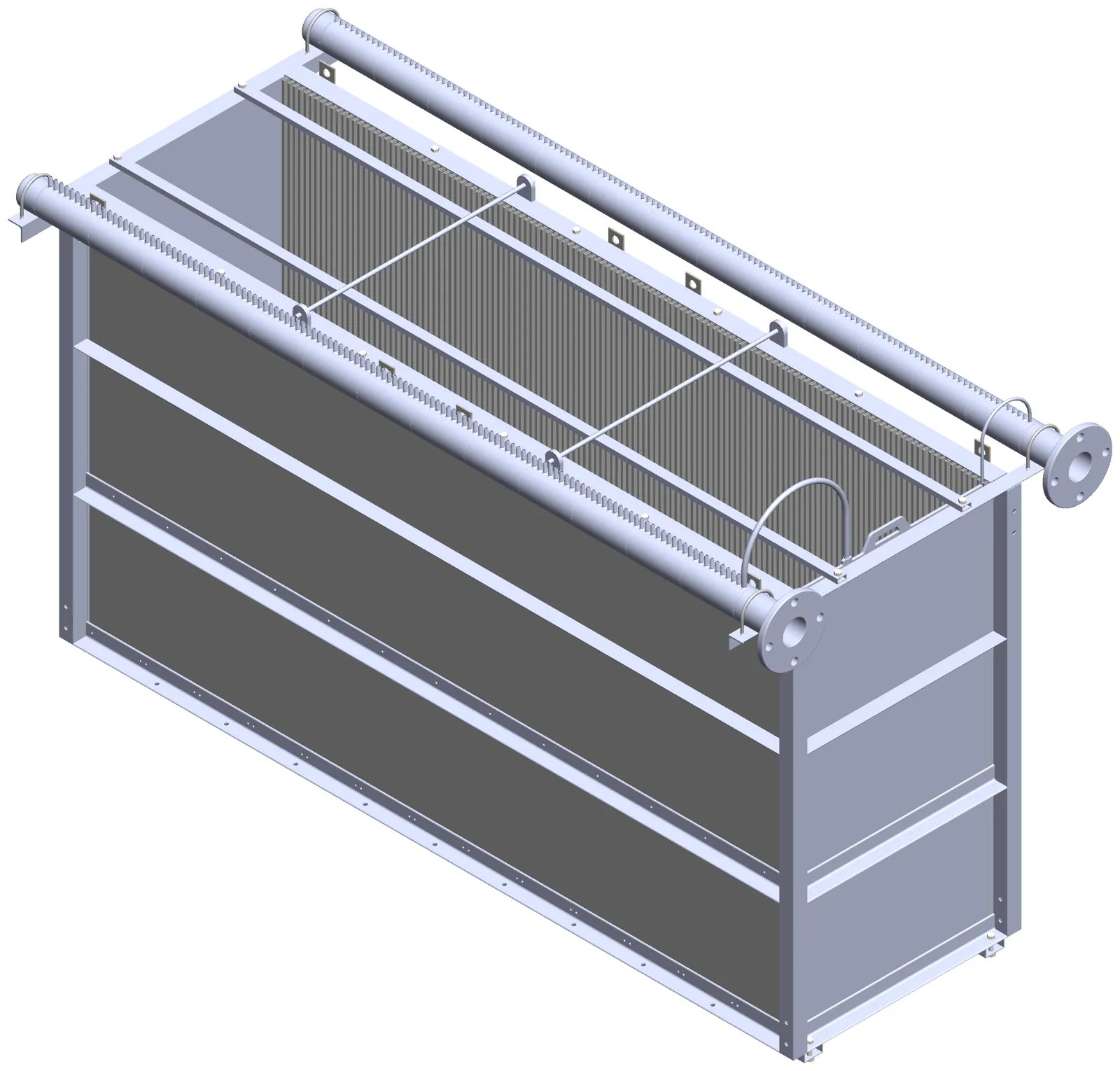
Full-flow vs partial-flow plates
Plate membranes come in two main constructions, and they differ most in how easily owners can service them on site.
| Item | Full-flow plate | Partial-flow plate (Palisade) |
|---|---|---|
| Plate construction | Plate perforated across its whole surface, like an open mesh | Each half of the plate is essentially its own filter |
| Membrane cavity | Membranes welded on both sides form a single cavity with two membranes | Separate filtering halves on one plate |
| Mounting | Plates usually fixed in place in the module | Plates slide into slotted guides, held down with a simple plate or bar |
| Connections | Built into the module | Silicone tubing on hose barbs |
| Owner maintenance | Disassembly can take time, so many owners replace the whole module at end of life | Easy for owners and operators to remove, replace and clean individual plates on site; plates can be heavy, so plan for lifting |
Swing thin-film cartridges take on-site service a step further: a single cartridge can be swapped in minutes without pulling the whole module.
Maintaining your own units
With Swing, operators can lift a single cartridge, look it over and swap it in minutes, often without specialist tools or factory service, which keeps downtime short. Palisade plates are partial-flow plates: each half of the plate works essentially as its own filter. Plates slide into slotted guides in the module, are held down with a simple plate or bar, and connect with silicone tubing via hose barbs. They can be heavy, but owners and operators can easily remove, replace and clean them on site. Either way, our team can walk your staff through the procedure.
Mild backwash (special cases only)
Backwashing is not a standard Swing operating mode and is not meant for routine use. Swing has been pressure-tested to 14.5 psi (1 bar) and held without breaking. If a site is in a bind even after relaxation and CIP, contact us; we may be able to work out a special mild-backwash procedure.
Which to choose
For most municipal and domestic projects we start with Swing, which is our most compact and economical option. Palisade suits plants that prefer a rigid plate. Send your flows and feed data and we will recommend a platform; see also how to choose.
Worked sizing example
Take a 158,503 gpd (600 m³/day) municipal plant comparing styles:
| Item | US | Metric | Note |
|---|---|---|---|
| Average flow | 158,503 gpd | 600 m³/day | about 110 gpm (25,000 L/h) |
| Design flux (gross) | 11.8 gfd | 20 LMH | Zyramic design guidance |
| Derate for relaxation and cleaning | ~20% | ~20% | |
| Net flux | ~9.4 gfd | ~16 LMH | |
| Membrane area needed | ~16,819 ft² | ~1,562 m² | average flow ÷ net flux |
| Swing-8 cartridges | ~125 | ~125 | 135 ft² (12.5 m²) each |
| Peak factor | ~2.0 | ~2.0 | |
| Peak flow | ~317,006 gpd | ~1,200 m³/day | extra area, short-term higher flux, or equalization |
This is an illustration only; a real design also checks temperature, MLSS, redundancy and the cleaning schedule.
Tips for a smooth project
- Compare modules on lifecycle, not area alone
- Plan how replacement parts will be sourced later
- Allow room for handling and inspection
- Check cassette dimensions before ordering replacements
Next step
A good way to see which design choices matter most for your plant is to look at your own maintenance history. Tell us what has needed attention in the past, and we will explain which of our options fits it best.
Sizing considerations
To give a useful recommendation we usually need:
- Average and peak flows
- Feed characteristics
- Tank dimensions
- Effluent limits
- Preferred maintenance approach
Most relevant product: Swing MBR. See also replacement membranes, rentals and how to choose.
Why engineers look at Zyramic flat-sheet modules
| Item | Details |
|---|---|
| Smaller sheets, less wear and tear | each sheet flexes less in service, and a damaged unit affects less area. |
| Strong wide membrane welds | designed to resist delamination over the membrane's life. |
| Thick, robust membrane | about 250 microns including support. |
| Assembled in Poughkeepsie, NY | of domestic and imported components. In our Poughkeepsie shop we cut and weld membrane sheets to plates, build module frames and assemble complete modules. For funded projects, tell us your domestic-content requirements and we'll review what we can document. |
| Buy, rent or replace | new modules, rentals and pilots for US projects, and replacement membranes that fit many existing cassettes. |
Performance and life depend on pretreatment, design flux and operation; flux figures are Zyramic design guidance, sized to each project.
Frequently asked questions
Is thin film as durable as plate?
Both are designed for robust service. Swing uses small sheets, strong wide membrane welds and a thick ~250-micron membrane.
Can I mix styles in one plant?
Often by train. We can review your layout.
Which is faster to service?
Swing cartridges can be swapped individually in minutes; Palisade plates are replaced individually.
Can I rent either?
Yes, every Zyramic module is available to buy or rent for US projects.